
Step inside our testing lab to see how we maintain professional output quality through rigorous technical analysis. We begin by evaluating Printer DPI, measuring the spatial dot density to ensure crisp text and high-resolution image reproduction. Next, our team analyzes the CMYK gamut using spectrophotometers to map the reachable color space and verify chromatic accuracy across the subtractive color model. Finally, we perform precise nozzle alignment calibration, adjusting print head timing and mechanical registration to eliminate banding and ensure exact droplet placement. This systematic evaluation guarantees that every device meets strict industry standards for color consistency and structural print integrity.
Our Printer Testing Environment
Precision in printer evaluation begins with a strictly controlled climate. Our testing lab maintains a constant ambient temperature of 23°C (±2°C) and a relative humidity of 50% (±5%) to ensure that ink viscosity and paper hygroscopy remain consistent throughout all trials. These parameters are critical because fluctuations in moisture can cause paper curling or alter the absorption rate of aqueous inks, leading to skewed results in saturation and drying times.
To prevent airborne particulates from interfering with the piezoelectric or thermal printheads, our facility utilizes a high-efficiency particulate air (HEPA) filtration system. This creates a clean-room atmosphere where "hickies" or dust-related artifacts are virtually eliminated. We also employ standardized D50 and D65 lighting conditions to evaluate output under neutral color temperatures, ensuring that metamerism-the phenomenon where colors change under different light sources-is accurately documented and analyzed.
- Climate Monitoring: Real-time logging of hygrometer and thermometer data.
- Air Purity: Positive pressure environment to repel external contaminants.
- Static Control: Anti-static flooring to prevent discharge during media handling.
Hardware and Equipment Used
Our lab is outfitted with professional-grade diagnostic tools designed to measure output with microscopic precision. We utilize X-Rite i1Pro 3 spectrophotometers for capturing colorimetric data and ensuring ICC profile accuracy. For physical measurements, we employ digital calipers with a resolution of 0.01mm to check mechanical feed consistency and margin alignment. High-resolution optical microscopes are used to inspect dot gain and the sharpness of individual droplets on various substrates.
Beyond the sensors, we utilize dedicated workstations equipped with calibrated EIZO ColorEdge monitors. This ensures that the soft proofing on our screens matches the hard copy output. We also implement densitometers to calculate the maximum optical density (Dmax) of black inks, which is a vital metric for determining the dynamic range and contrast ratio of both inkjet and laser systems.
| Equipment Type | Model/Standard | Primary Function |
|---|---|---|
| Spectrophotometer | i1Pro 3 Plus | Color accuracy and profiling |
| Microscope | Digital 400x | Dot geometry and satellite drops |
| Lux Meter | Extech LT300 | Illuminance level verification |
Standardized Test Page Selection
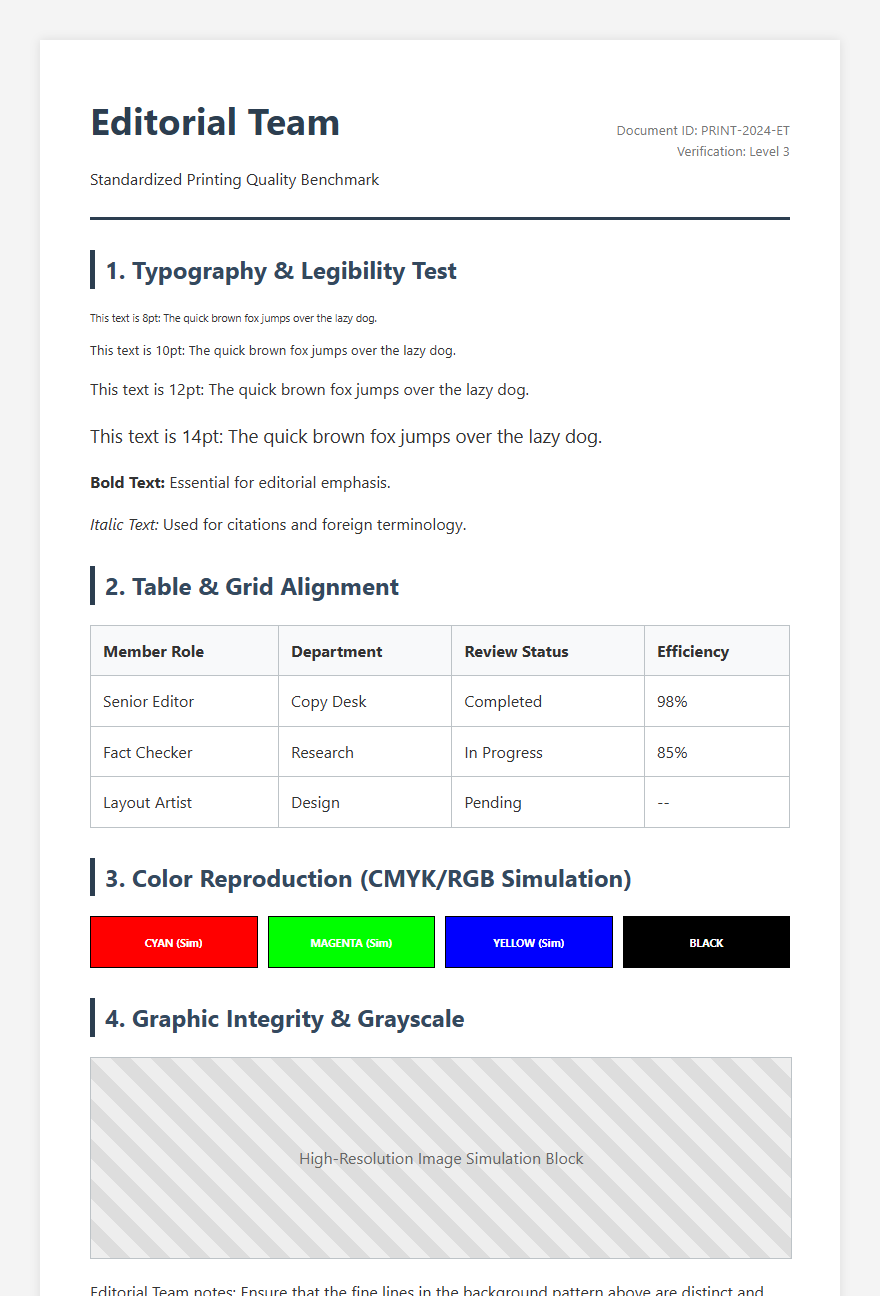
The core of our diagnostic process relies on a suite of standardized test pages specifically engineered to push hardware to its limits. These files are not mere photographs; they are complex vector and raster composites containing CMYK color ramps, radial gradients, and fine-line lattices. By utilizing these specialized patterns, we can identify specific mechanical failures such as micro-banding, ghosting, or jitter that standard document printing might overlook.
Each test page includes "torture tests" for the printer's firmware, such as intricate moiré patterns and font rendering down to 1-point size. These elements allow us to evaluate the raster image processor (RIP) and the machine's ability to handle complex paths without aliasing. We also incorporate solid color blocks to check for ink pooling and inter-color bleed, which are essential indicators of how the printer manages high-coverage liquid deposition on non-porous media.
- Color Ramps: 0% to 100% saturation checks for smooth transitions.
- Line Art: 0.1pt thickness lines to test addressable resolution.
- Text Clarity: Serif and sans-serif fonts at extreme scales.
Color Calibration Protocols
Achieving color fidelity requires a rigorous multi-step calibration protocol. Before any performance testing begins, we perform a baseline "out-of-the-box" print to see the manufacturer's default bias. Following this, we use spectrophotometry to generate custom ICC profiles for every ink and paper combination. This process involves printing a target sheet with hundreds of color patches, which are then scanned to create a mathematical map of the printer's unique color gamut.
We measure success using Delta E (ÎE) formulas, specifically the CIE76 and dE2000 standards. A Delta E value of less than 1.0 is considered imperceptible to the human eye, and our goal is to determine how closely a printer can maintain this level of accuracy across the entire spectrum. This protocol also accounts for "white point" adjustments, ensuring the paper's natural tint does not skew the perceived warmth or coolness of the final image.
- Linearization of ink channels to ensure proportional output.
- Target patch printing and spectrophotometer scanning.
- Profile generation and gamut boundary verification.
- Validation through "Color Checker" verification prints.
Grayscale Accuracy Benchmarks
Monochrome performance is often the hardest metric for color printers to master, as it requires a perfect balance of Cyan, Magenta, and Yellow inks to create a neutral gray without a color cast. Our grayscale accuracy benchmarks focus on identifying "bronzing" or "metameric failure," where blacks appear greenish or magenta under certain lighting. We analyze the neutrality of the gray ramp from deep shadows (Zone 0) to bright highlights (Zone X).
We specifically look for tonal separation in the dark regions of the print. A high-quality printer should be able to distinguish between 95% black and 100% black without "clogging" the shadows into a single dark mass. Our tests utilize dither pattern analysis to see how the printer's algorithms distribute black droplets to mimic smooth gray washes. This is essential for professional photography and technical architectural drawings where precision shading is a requirement for depth perception.
- Neutrality Check: Measuring a* and b* values in the Lab color space.
- Dmax Testing: Determining the absolute blackest point possible.
- Highlight Retention: Ensuring 1% to 5% tints remain visible.
Nozzle Integrity Assessment
The mechanical health of a printhead is vital for long-term reliability. Our nozzle integrity assessment involves high-frequency firing tests to check for "misdirected" or "clogged" nozzles. In inkjet systems, we look for satellite drops-tiny, unintended ink splatters that occur when the droplet break-off is inconsistent. These imperfections often lead to a "fuzzy" appearance on sharp edges and are a primary indicator of head wear or poor ink formulation.
During extended print runs, we monitor for "nozzle drop-out," which occurs when a nozzle stops firing due to air bubbles or dried ink. We utilize an automated check-and-clean cycle analysis to determine how much ink is "wasted" during maintenance routines. For laser printers, this section focuses on the integrity of the corona wire and the developer unit, ensuring that the electrostatic charge is uniform across the entire drum surface to prevent "voids" or repetitive spotting.
- Initial nozzle check pattern verification.
- Stress test with 50 pages of high-density coverage.
- Post-stress nozzle check to identify heat-induced failures.
- Macro-photography analysis of droplet placement accuracy.
Print Resolution Analysis
Resolution is more than just a DPI (dots per inch) number on a spec sheet; it is the printer's ability to render distinct, non-overlapping detail. In our resolution analysis, we use the "Line Pairs per Millimeter" (lp/mm) metric to define the true optical resolution of the output. We print converging lines (Ronchi rulings) to find the exact point where the lines blur together, providing a concrete limit for the machine's resolving power.
We also evaluate the printer's interpolation algorithms. When a low-resolution file is sent to a high-resolution printer, the firmware must "fill in the gaps." We test how effectively the printer handles this upscaling without creating "stair-stepping" or aliasing artifacts. This section also covers "edge acutance," which measures the transition from a dark edge to a light background; a sharper transition indicates superior motion control of the print carriage and better ink-droplet timing.
- Spatial Resolution: Vertical vs. horizontal resolution consistency.
- Addressable DPI: Verifying hardware limits against software claims.
- Edge Sharpness: Using 20x magnification to inspect text "jaggies."
Media and Paper Standards
The substrate used is just as important as the printer itself. To ensure fairness, we test every printer using a variety of standardized media types, ranging from 80 GSM bond paper to 300 GSM heavy-weight archival luster. We measure "show-through" or opacity to see how much ink penetrates the fibers, which is critical for duplex (double-sided) printing. Our lab also checks for "media cockle"-the warping of paper when saturated with heavy ink loads.
Different coatings react differently to pigments and dyes. We evaluate how the printer's "media sensor" identifies the paper type and whether it adjusts the "head strike" height accordingly. This prevents the mechanical printhead from physically touching the paper surface, which can cause smearing or damage. We also document the "caliper" or thickness of the paper to ensure the feed rollers are not inducing "skew" or slipping during the high-speed intake phase.
| Substrate Type | Weight (GSM) | Application |
|---|---|---|
| Plain Office Bond | 80 - 90 | General text and drafts |
| Matte Presentation | 120 - 170 | Graphics and charts |
| Premium Glossy | 250+ | Photo and high-end marketing |
Evaluation Methodology
Our evaluation methodology combines quantitative data with qualitative expert observation to provide a holistic view of printer performance. We utilize a "Scoring Matrix" that weights different attributes-such as speed, color accuracy, and ink economy-based on the printer's intended market (e.g., home office vs. professional studio). Each test is repeated five times to calculate an average and identify any outliers that might suggest a manufacturing defect rather than a design flaw.
The qualitative side involves "blind" panel testing, where print samples are viewed by technicians under standardized D50 lighting. They look for subjective qualities like "flesh tone naturalism" and "perceived depth," which numbers alone cannot always capture. This dual-path approach ensures that we don't just tell you if a printer is technically accurate, but also if the output is aesthetically pleasing to the end-user. All data is then cross-referenced against the manufacturer's advertised specifications for transparency.
- Data collection via sensors and software.
- Subjective visual inspection by color specialists.
- Statistical averaging of multiple test runs.
- Comparative analysis against industry-leading benchmarks.
Data Measurement Tools
The "Data Measurement" phase is where raw prints are converted into actionable statistics. We use specialized software like Argyll CMS or ColorThink Pro to visualize the 3D gamut volume of a printer. This allows us to see exactly which colors a printer struggles to reproduce-for instance, a printer might have excellent reds but lack the "reach" to display vibrant turquoise or deep violets. These "gamut maps" are essential for photographers who need to know if their images will be "clipped" during printing.
Additionally, we use high-speed stopwatches to measure "First Page Out Time" (FPOT) and "Pages Per Minute" (PPM). We don't just measure the time the paper is moving; we include the "processing time" from the moment the "Print" button is clicked. This provides a realistic view of how the printer's internal processor and RAM handle large, data-heavy files, which is a common bottleneck in modern office workflows.
- Gamut Mapping: 3D visualization of reproducible color space.
- Throughput Timing: Measuring engine speed vs. processing speed.
- Ink Consumption: Weighing cartridges before and after large runs.
Testing Reliability Standards
Consistency is the hallmark of a professional testing lab. To maintain our reliability standards, we perform "inter-instrument agreement" checks, where multiple spectrophotometers are compared against a reference tile to ensure they are all reading the same values. We also implement a "Reference Printer" protocol: a high-end, calibrated machine is used to print a control sheet every week to ensure our lab conditions haven't shifted and that our baseline remains stable.
We also subject printers to "long-cycle" reliability tests. This involves printing 500+ pages consecutively to observe "thermal throttling" in laser printers or "ink starvation" in inkjet systems. By pushing the hardware beyond a typical few-page test, we can identify heat-related degradation in image quality or mechanical fatigue in the paper-handling rollers. This rigorous approach ensures that our findings are repeatable and that the results we publish today will hold true throughout the printer's lifecycle.
- Weekly sensor recalibration against NIST-traceable standards.
- Cross-verification of data across different technicians.
- Stress-testing hardware for thermal and mechanical fatigue.
- Continuous environmental logging for audit trails.
Post-Print Inspection Workflow
Once the printer has completed its task, the inspection workflow begins. We do not measure prints immediately; instead, we allow for a "dry-down" period. Inkjet prints, particularly those using pigment inks, can shift in color and density as the carrier fluid evaporates and the resins set. We typically wait 24 hours before taking final spectrophotometric readings to ensure the data reflects the permanent state of the print. This prevents "wet-state" inaccuracies from skewing our color scores.
Following the stabilization period, we conduct "rub tests" and "smudge resistance" evaluations to check ink-to-media adhesion. We also utilize a "light box" to simulate various lighting environments, checking for UV sensitivity and ozone resistance if the ink formulation claims archival properties. This final stage ensures that the output is not only beautiful when it leaves the tray but remains durable and color-accurate for years to come under normal display conditions.
- Stabilization Period: 24-hour wait time for ink curing.
- Adhesion Testing: Mechanical rub-resistance checks.
- Longevity Simulation: Accelerated aging observations under high-intensity light.

Comments